
Table Games
How to Play Baccarat
Baccarat is a card game in which you bet on which of two hands — Player or Banker — will finish with a total closer to nine, or whether they will tie. You make no decisions after placing your bet; fixed rules decide whether each hand draws a third card.
Card values and totals
| Cards | Value |
|---|---|
| Ace | 1 |
| 2 to 9 | Face value |
| 10, Jack, Queen, King | 0 |
A hand's total is the last digit of the sum of its cards. For example, 7 + 8 = 15, so the hand counts as 5. The highest possible total is 9.
Naturals
If either the Player or Banker has 8 or 9 with the first two cards, that is a natural. Both hands stand and the round is decided immediately.
The third-card rule
If there is no natural, the Player hand acts first: it draws a third card on a total of 0–5 and stands on 6 or 7.
If the Player stood, the Banker draws on 0–5 and stands on 6 or 7. If the Player drew a third card, the Banker follows this table:
| Banker total | Banker draws when the Player's third card is | Banker stands when the Player's third card is |
|---|---|---|
| 0, 1, 2 | Any card | — |
| 3 | Anything except 8 | 8 |
| 4 | 2 to 7 | 0, 1, 8, 9 |
| 5 | 4 to 7 | 0 to 3, 8, 9 |
| 6 | 6 or 7 | 0 to 5, 8, 9 |
| 7 | — | Always stands |
Bets, payouts and house edge
| Bet | Payout | House edge (8 decks) |
|---|---|---|
| Banker | 1:1 minus 5% commission | About 1.06% |
| Player | 1:1 | About 1.24% |
| Tie | 8:1 | About 14.4% |
If the result is a tie, Player and Banker bets are normally returned (a push). The Tie bet pays well when it wins, but its house edge is many times higher than the two main bets.
Example hand
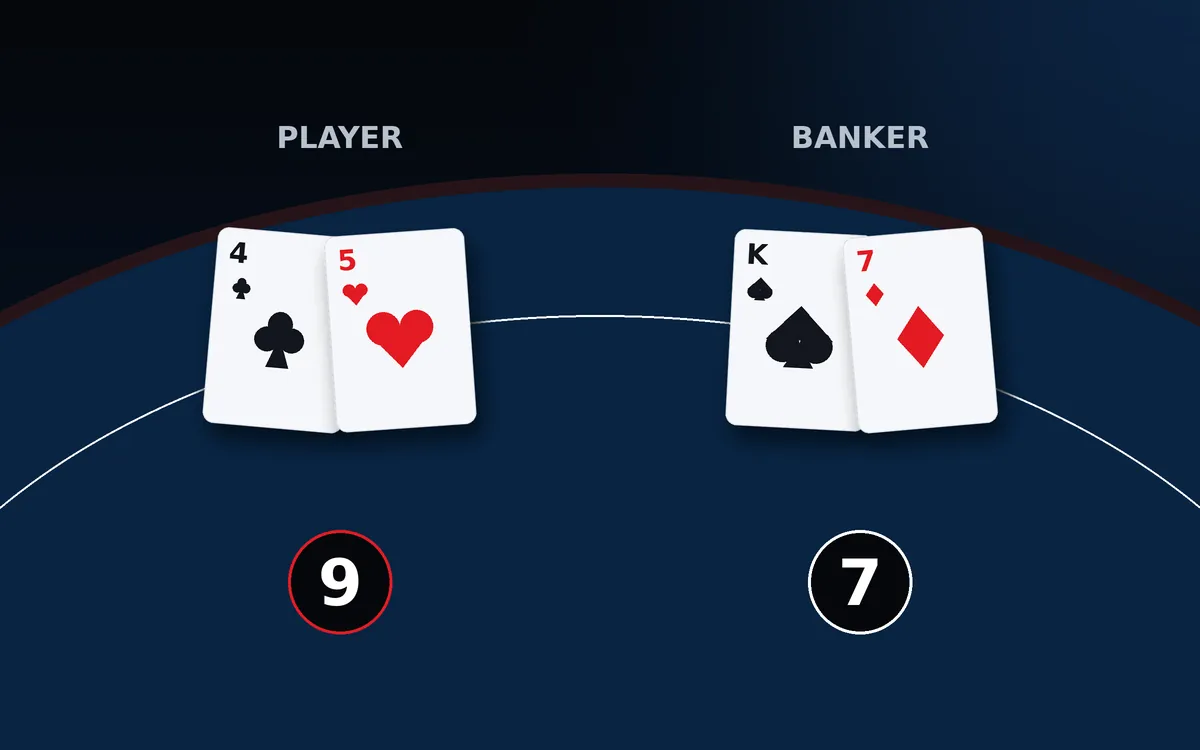
Player is dealt 4 and 5: a total of 9, a natural. Banker is dealt King and 7: a total of 7. Player wins, and no third cards are drawn.
Key points
- Baccarat needs no strategic decisions once your bet is placed.
- Scorecards of past results do not predict future rounds.
- No betting system changes the house edge.
Want to see how the game runs with a real dealer? Read the live baccarat guide