
Slots
What Is Slot RTP?
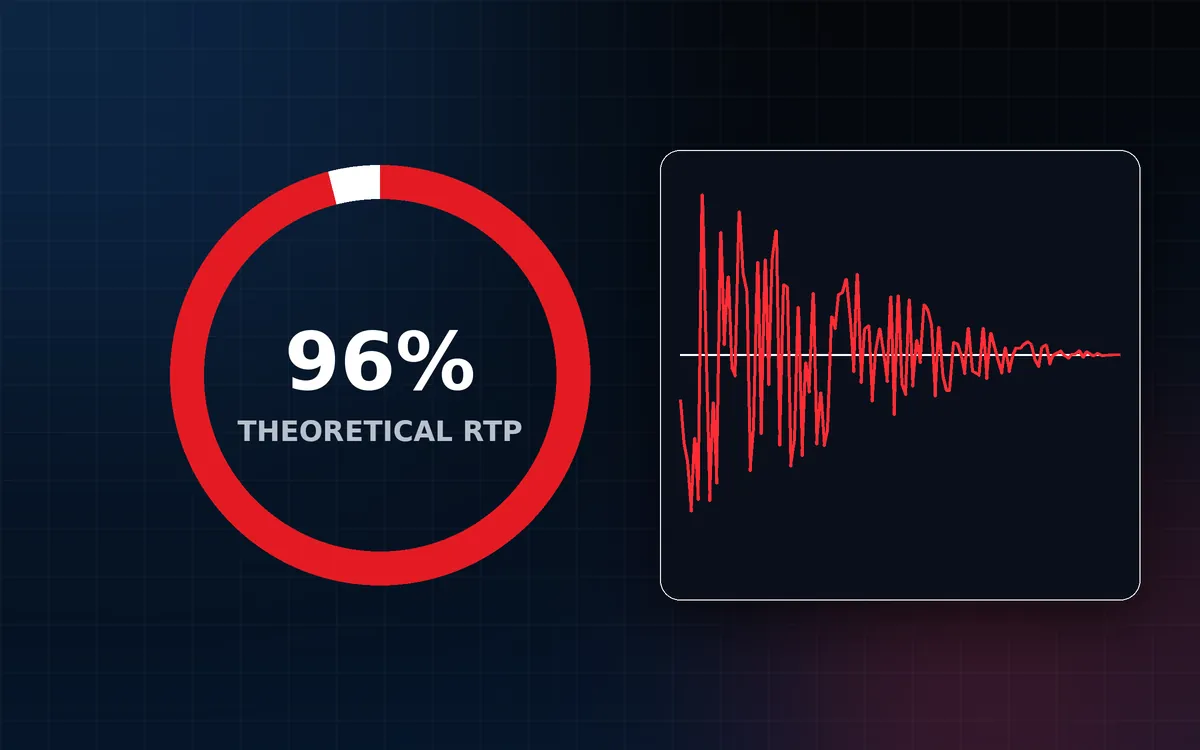
RTP (return to player) is the percentage of all money wagered on a slot that the game is designed to pay back to players over a very large number of spins. A 96% RTP is a theoretical long-term average, not a promise about any player or session.
Key points
- RTP is a long-term theoretical average across all players and a very large number of spins.
- House edge equals 100% minus RTP.
- RTP does not predict the result of any individual session or spin.
- Always check the RTP shown inside the game's own information screen.
What RTP means
A slot's RTP is calculated from its maths model: every possible outcome, its probability and its payout. Adding these together gives the share of total stakes the game is expected to return in the long run. Testing laboratories confirm the figure by simulating very large numbers of spins, typically millions or more.
A game with a 96% RTP is designed to return, on average, about RM96 for every RM100 wagered across all players over its lifetime. The remaining share is the house edge.
RTP and house edge
| RTP | House edge | Theoretical average cost per RM100 wagered |
|---|---|---|
| 94% | 6% | RM6 |
| 95% | 5% | RM5 |
| 96% | 4% | RM4 |
| 97% | 3% | RM3 |
| 98% | 2% | RM2 |
"Wagered" means total stakes placed, not the amount you deposit. If you replay winnings, the same money is wagered several times, and the house edge applies to every bet.
A worked example
Imagine 500 spins at RM1 each on a 96% RTP game. That is RM500 wagered in total. The theoretical average return is RM480, a theoretical cost of RM20.
In practice, a single player's result over 500 spins could be far above or far below RM480. One player might hit a large feature and finish ahead; another might lose most of the RM500. The 96% only describes the average across an enormous number of spins.
Why your session can differ
Short sessions are dominated by randomness. How far results swing from the average depends on the game's volatility: high-volatility slots can pay far below RTP for long stretches because much of their return is concentrated in rare large wins.
This is why RTP is best used to compare games, not to predict what you will get back.
Where to find RTP
- Open the game's information, help or rules screen. Regulated games generally display their RTP there.
- Some game studios release the same title in several RTP configurations. The figure inside the game you are playing is the one that applies.
- Bonus-buy features and special modes can have a different RTP from the base game.
What RTP does not tell you
- It does not guarantee any return to an individual player.
- It does not mean a game "owes" a payout after losses.
- It does not describe how often wins land. That is volatility and hit frequency.
- It does not make gambling a way to earn money. Over time, the house edge means players as a group lose more than they win.